Lucía Miranda presents her new work at the Centro Dramático Nacional, following previous successes such as Caperucita en Manhattan (Little Red Riding Hood in Manhattan) and La cabeza del dragón (The Dragon’s Head).
The Cross Border company delves into the shared history of Spain and the Philippines through a mosaic of numerous characters performed by a cast made up mostly of Filipino artists.
Las últimas is a documentary theatre piece that blends the most eccentric fictionalizations of historical episodes with interviews conducted with more than forty people, whose testimonies about their families’ legacies have shaped the dramaturgy of the production.
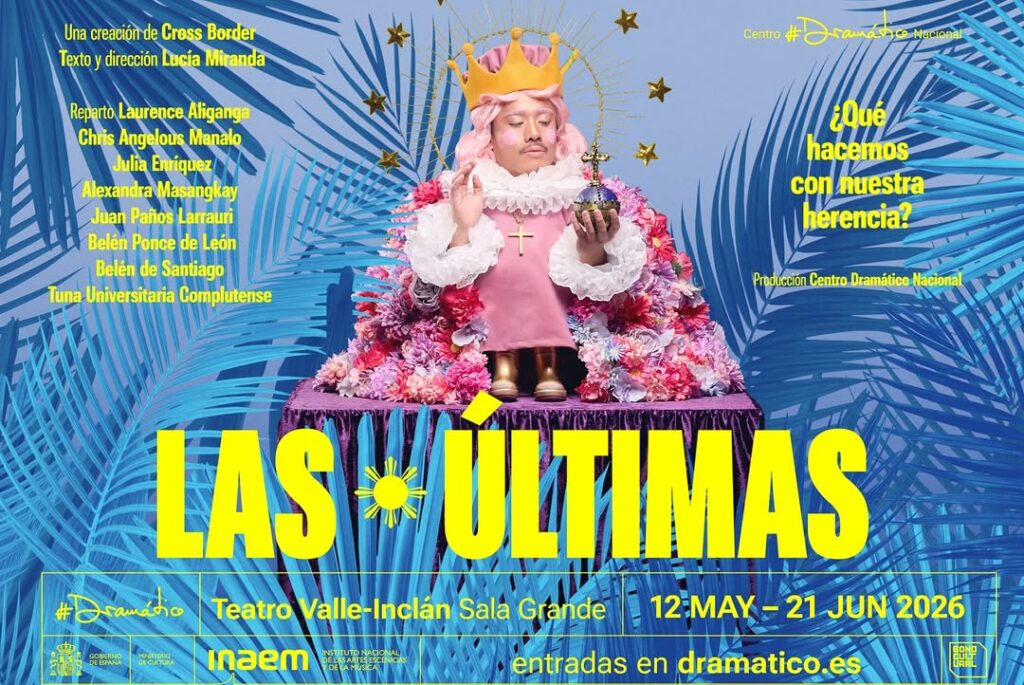
Madrid, May 7, 2026. With the curtain still closed, Belén Ponce de León steps onto the stage. She is the mother, the homeland, the Matria brought to life. And she has stage 4 cancer, the most severe and aggressive form. With that declaration begins Las últimas, the latest work by the Cross Border company, written and directed by Lucía Miranda. The play, which intertwines fact and fiction to tell the story of Spain and the Philippines, will be performed in the main hall of the Teatro Valle-Inclán from May 12 to June 21, in a production by the Centro Dramático Nacional.
The production explores the inheritance left behind by the relationship between the two countries — and what to do with it now. Thus, the cast—comprised of Belén Ponce de León, Laurence Aliganga, Julia Enríquez, Chris Angelous Manalo, Alexandra Masangkay, Juan Paños Larrauri, and Belén de Santiago—is primarily of Filipino origin. “It was very important to me that this story be told by a team that represents the diversity of those heritages,” says Miranda.
Lucía Miranda describes this as her most personal work and the one that demanded the most research. “I’ve done 40 interviews between Spain and the Philippines—about 80 hours of audio—including interviews with the cast members and their mothers.” She sought a wide variety of profiles that reflected on heritage through themes such as language, religion, identity, the body, purchasing power, and social class.
In addition to combining “a very wild, funny fiction with a deeply sincere documentary,” Miranda also “draws a thread between the personal and the political” by discussing a mother’s cancer—both her own mother’s illness, which inspired the play’s theme of inheritance and its more accessible tone, and the illness of the matria, symbolizing colonialism that endures to this day. “You inherit some things from your mother, and others from your country. The conflict lies in deciding what to do with what you’ve inherited.”
The piece is built around these interviews and five historical moments that Miranda has fictionalized: “Clearly, I’ve filtered them through my own perspective. I’m not trying to give a history lesson, but rather to provoke questions—if people want real facts, they can turn to the books. The rigor, for me, lies in the living voices of those who entrusted me with their stories and who will come to see the show. History, I’ve speculated about; people, I’ve honored.”
A karaoke full of music and color to talk about our heritage
Lucía Miranda has reconfigured the main hall of the Teatro Valle-Inclán into a four-sided stage, so the audience surrounds the action as if inside a karaoke bar, with a central stage where the performers sing and act. The show also features members of the Complutense University Tuna, a traditional female music group, who will perform alongside the actors. Music, composed by Nacho Bilbao, plays a central role. Musical direction is shared by Laurence Aliganga and Nacho Bilbao, with sound design by Eduardo Ruiz “Chini.” Choreography is by Chris Angelous Manalo.
Miranda’s distinctive theatrical language fills the stage with vivid visual imagery. Anna Tusell designed the colorful costumes, blending tradition and modernity. Johnny Dean created the makeup and characterization for both historical and contemporary characters. The set design by Alessio Meloni and lighting by Pedro Yagüe lend vibrancy to the stage, while video projections are by Javier Burgos.
In this staging, the audience encounters multiple layers of characters. The first and most vulnerable layer is that of the performers themselves, exploring their relationship with the Philippines and their ancestors. The second layer builds on contemporary interviews, using the verbatim documentary technique, faithfully replicating real speech. Finally, historical characters—some well-known, others obscure—appear and interact with the present-day lens, blending genres from musical to thriller to circus.
The cast journeys through 461 years of history, using various artworks as narrative engines. “I thought: which works best represent the relationship between the two countries? If artists of the time reflected on these moments, then those works can serve as my documentary anchors,” explains Miranda.
Las últimas runs from May 12 to June 21 in the main hall of the Teatro Valle-Inclán.
DIRECTOR’S NOTE
Three days before I took my flight to the Philippines to do the research for this piece, my mother told me she had cancer. When I landed and got into the car with J-mee Katanyag, the Artistic Director of PETA, our partner company in Manila, I broke down crying: “Right now I don’t give a shit about colonialism. Right now the only thing that matters to me is my mother.”
The next day, J-mee brought me Noli Me Tangere, José Rizal’s book, a cornerstone of the Philippines’ independence from Spain. And there it was, in the prologue: cancer and the mother, the motherland. In the Philippines, nature fights to break through the asphalt, like my mother’s cancer cells fighting to reproduce.
Las últimas is my most personal work, and also the one that has required the most research (40 people interviewed). It’s a mix of the purest documentary theatre — the verbatim work we’ve done demands a word-for-word transcription and embodiment of the characters — and the wildest fictional speculation, because, as Françoise Vergès says: “A decolonial exercise consists of imagining what other forms of exhibition and representation could be.”
It speaks about the shared history of the Philippines and Spain, about inheritance, and about what we do with it. Las últimas is my personal panata: a team inviting an audience to invoke the gods of theatre, so that our mothers know how much we love them.
Lucía Miranda
ACTOR’S PROFILE: Julia Enriquez
Julia Enriquez, a Filipino artist and playwright, is a Senior Artist-Teacher at the Philippine Educational Theater Association (PETA), a Ramon Magsaysay Award-winning institution renowned for its socially engaged theater.
Her work spans both stage and screen, with film and television credits including Heneral Luna, Comeback, and Violator. In theater, she has performed in award-winning productions and was nominated for Best Actress. As a playwright and head screenwriter, she has developed works for the stage and digital platforms, including Dalaga na si Maximo Oliveros: A Drag Musical Extravaganza.
She has performed and collaborated internationally, including work with the Mecklenburgisches Staatstheater in Germany, Outil Théâtre in France, and the United Nations World Urban Forum in Canada, extending her reach across Europe, the United States, and Asia.
She was honored with the Loyola Schools Award for the Arts from Ateneo de Manila University and previously served as the head of the Culture and Arts Unit at De La Salle–College of Saint Benilde. Her work explores themes of inclusion and empowerment through performance and arts education. As a facilitator, she works closely with communities, leading workshops, developing programs, and engaging in research-based creative practices.
The Last Ones (Las últimas)
A Cross Border Production
Written and Directed by: Lucía Miranda
Production: Centro Dramático Nacional
In collaboration with:
PETA (Philippine Educational Theater Association), Embassy of the Philippines in Spain, Casa Asia, and Instituto Cervantes de Manila.
Performances
Dates: May 12 to June 21, 2026
Schedule: Tuesday to Sunday at 8:00 PM (20:00 h)
Venue: Teatro Valle-Inclán | Sala Grande
Cast & Crew
Cast
Laurence Aliganga, Chris Angelous Manalo, Julia Enríquez, Alexandra Masangkay, Juan Paños Larrauri, Belén Ponce de León, Belén de Santiago, Tuna Universitaria Complutense.
Artistic Team
Creation: Cross Border
Text & Direction: Lucía Miranda
Set Design: Alessio Meloni
Lighting Design: Pedro Yagüe
Costume Design: Anna Tusell
Music: Nacho Bilbao
Musical Direction: Laurence Aliganga and Nacho Bilbao
Sound Design: Eduardo Ruiz “Chini”
Choreography: Chris Angelous
Video Design: Javier Burgos
Characterization/Makeup: Johny Dean
Assistant Director: Anahí Beholi
Assistant Set Designer: Mauro Coll
Assistant Lighting Designer: Elena Alejandre
Assistant Costume Designer: David Degea
Subtitles: Juan Ollero
Interns: Ares B. Fernández (Direction), Talía del Val (Direction), Elvira Arcos (Mediation), Carlo Laureana (Dramaturgy), Harold Ron Fajardo (Sound), Pablo Jiménez (Costumes)
Visuals & Construction
Poster Design: Emilio Lorente
Photography & Trailer: Bárbara Sánchez Palomero
Set Construction: SCNIK MÓVIL
Costume Construction: Gabriel Blesa and Matías Zanotti
Wardrobe Aging/Distressing: Marisa Echarri and Lola Trives